Chongqing – In movies and novels, the “thousand-year lingzhi” is often portrayed as a miracle cure that can bring the dead back to life. But deep in the Daba Mountains, farmer-entrepreneur Hu Anling tells us: that is just a legend. On the afternoon of April 8, a reporter from the WCICO visited his lingzhi cultivation base in Gaoyan Town, Chengkou County.
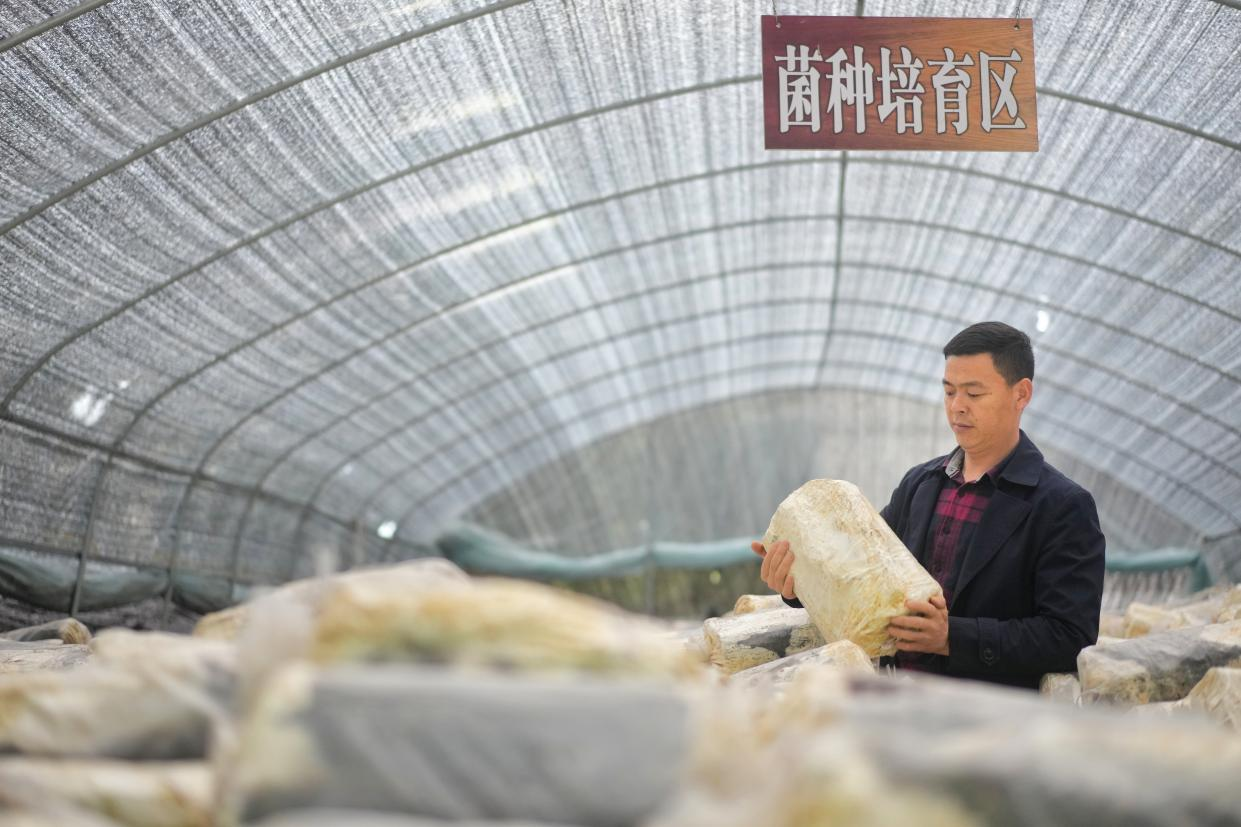
Hu Anling inspects the fungus sticks in the greenhouse.
“Lingzhi does not improve with age,” says 40-year-old Hu Anling. Once it matures and releases its spores, the lingzhi becomes woody, stops growing, and if left longer, it will only rot or be eaten by insects. Its medicinal value declines, leaving it with little more than ornamental worth. Moreover, no medicine can truly bring the dead back to life, but lingzhi is indeed a valuable herb that can help regulate immunity, improve sleep, and combat fatigue.
Hu Anling is the head of Chengkou Anling Agricultural Development Co., Ltd. In 2019, after years of selling medicinal herbs outside his hometown, he decided to return and start a business by planting 3 mu of lingzhi. The beginning was not smooth—the first attempt, based on his experience, failed completely. He traveled to Guizhou to learn, sought guidance from professors at Southwest University, and even hired experts from Zhejiang at high salaries to provide on-site instruction. After setbacks including being cheated by a partner and low yields, he finally visited Longquan in Zhejiang—known as the “Hometown of Chinese Lingzhi”—to introduce high-quality red lingzhi and technical talent. Only then did his venture truly get on the right track.
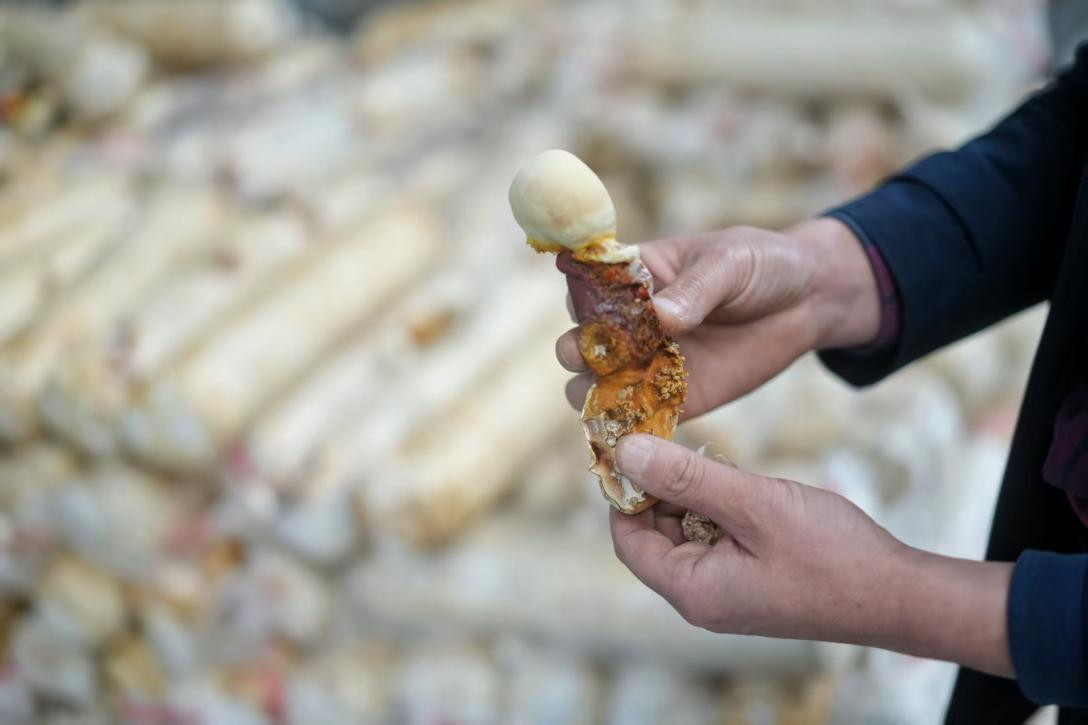
Hu Anling displays mature lingzhi mushrooms.
Lingzhi cultivation is far from simple. Hu Anling uses oak wood to make the fungus sticks. This hardwood is rich in polysaccharides and helps improve the quality of the lingzhi. The sticks must be sterilized at over 100°C. About one month after inoculation, they are covered with white mycelium and then transplanted into greenhouses. Each fungus stick grows for two years and is sprayed with powder only once. After harvest, the spore powder must be stored in cold storage at 0–8°C.
Today, Hu Anling has established three planting bases. The area has expanded from the initial 3 mu to 47 mu, and is expected to reach 90 mu this year. In 2024, the company produced 6.2 tons of lingzhi spore powder, made into approximately 20,000 boxes of spore powder capsules, generating an output value of 10 million yuan. The products are sold not only in Chongqing and Anhui, but have also achieved Chengkou’s first foreign trade orders—exporting USD 100,000 worth of goods to Los Angeles in the United States, Singapore, and Hong Kong.
Testing shows that the key active ingredient—polysaccharides—in Hu Anling’s lingzhi reaches 73.21%, far exceeding the national standard. His products are registered under the trademarks “Anling Pavilion” and “Qin Zhi Valley,” and they leverage the local regional public brand “Daba Mountain Herb Valley” to open up broader markets.
Hu Anling has also driven employment for surrounding farmers. The company pays more than 600,000 yuan in labor fees each year, allowing many villagers to find jobs near their homes. The effect of “one person leading a group, lifting an entire region” is gradually taking shape.
“The thousand-year lingzhi is just a story,”Hu Anling says.“Real high-quality lingzhi depends on technology, patience, and these mountains.”
Reporter: Yang Jinxing
Editor: Jiang Jinggu
Director: Luo Jia
重庆国际新闻中心由重庆市政府新闻办主办,西部国际传播中心运营,是集新媒体内容生产、分发、统计于一体的融媒体平台。
目前,重庆国际新闻中心已有注册海内外媒体184家,注册记者3800名,涵盖欧美、日韩、东南亚等海外媒体,人民日报、新华社、中央电视台等中央媒体,以及全国各省市重点媒体。
同时,重庆国际新闻中心还具备线上新闻发布功能,能够实现“登录一平台,面向全世界”。
联系人:罗嘉 联系电话:18623411433