Chongqing – On the afternoon of April 8, after the rain had cleared, a reporter from the WCICO visited the Coptis (Huanglian) planting base in Gaoyan Town, Chengkou County.
In traditional Chinese medicine cultivation, Huanglian is known as the “lazy medicinal herb.” Once planted, it doesn’t require daily attention or annual replanting. With extensive management, it can grow steadily and yield reliably for three to five years. It is especially suitable for farmers in mountainous areas, under forest canopies, or those who don’t have time for intensive care. In the words of local herb farmers, it is “a Chinese Herbal Medicine that even lazy people can grow.”
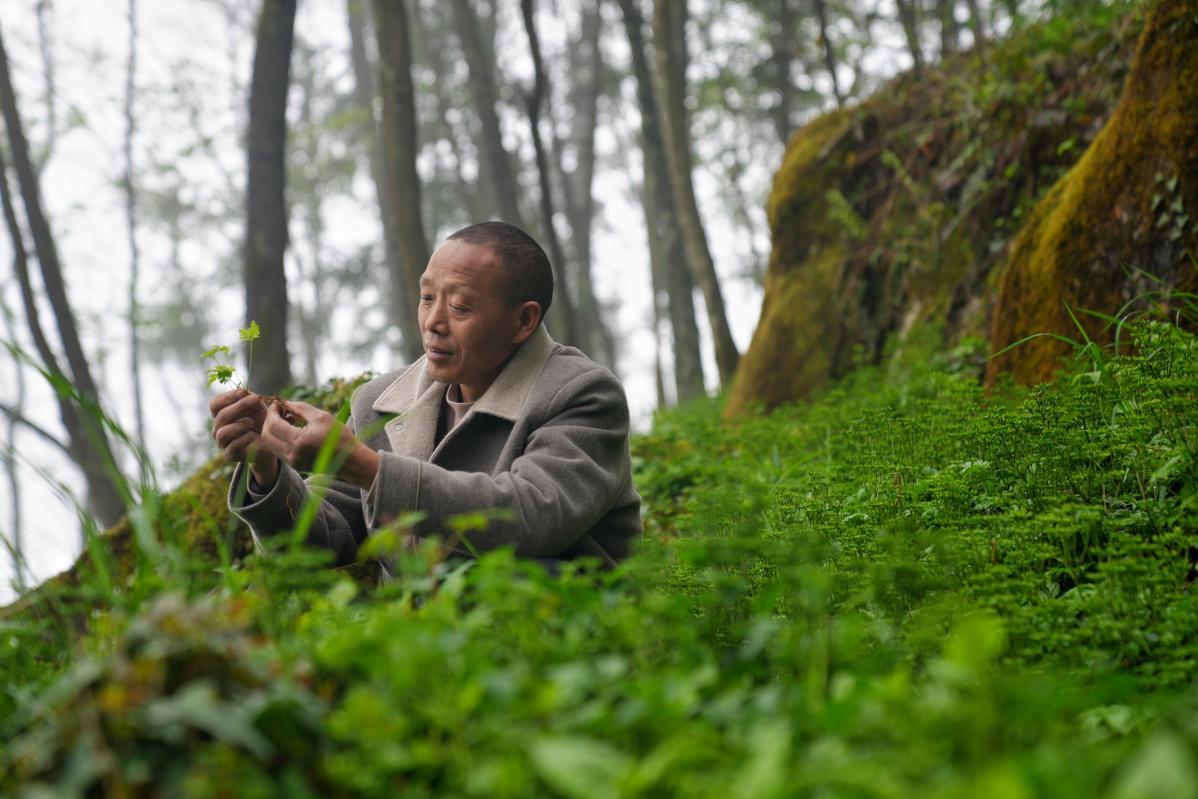
Li Ming inspects the Chinese goldthread in the cultivation base. Photo by Luo Jia
Yet in the Daba Mountains of Chengkou County, Chongqing, returning farmer Li Ming does exactly the opposite.
Chengkou County sits at the northernmost tip of Chongqing, with forest coverage 72.8%. However, arable land is extremely scarce, and it is difficult to find large stretches of flat terrain. Locals have long understood that to get rich, they must look to the forests for opportunities. Fifty-six-year-old Li Ming used to raise pigs, with his herd once reaching 4,000 head. In 2021, he decided to transform his business. He contracted forestland at an altitude of 1,300 to 1,500 meters and began planting the locally native Coptis chinensis.
Huanglian is known as a “lazy medicinal herb,” but Li Ming has turned this “lazy herb” into a “slow business.” He waits a full eight years before harvesting. Every year, he weeds twice and adds soil once, spending day after day working in the forest. Just the process from seed breeding to planting took him more than six months. “Most Huanglian on the market is harvested after three or five years,” he says. “Mine has to wait eight years. Only through natural growth can the medicinal efficacy be sufficient.”
A slow approach requires money to sustain it. Over 2,000 mu (about 133 hectares) of forestland meant heavy upfront investment and no immediate returns in sight. Would any bank lend money to a farmer whose returns wouldn’t come for eight years?
The turning point came from a reform pioneered by Chengkou County in Chongqing: the city became the first to issue “Forest Operation Revenue Rights Certificates,” allowing the long-term operating revenue rights of forestland to be used as collateral for loans. Li Ming secured a loan of 1 million yuan. “With this money, the base could finally get moving,” he said. So far, the county has issued five such certificates, enabling 6 million yuan in pledged loans.
Today, Li Ming’s plantation has expanded to 2,300 mu, and last year alone it paid out 1.08 million yuan in wages, employing nearby villagers—many of them women and elderly residents. He not only sells seedlings and seeds, but has also begun developing innovative products. For example, he makes wellness tea from the whole Coptis plant using a traditional nine-steaming and nine-drying process. This fresh product has gained market recognition, with added value far higher than selling raw materials. The herb seeds can also be processed into a coffee-like beverage. Together with partners, he has also launched a traditional Chinese medicine toothpaste. The factory is about to break ground, and the local government has provided support for construction and equipment purchase.
“Waiting eight years to sell is indeed a bit slow,” Li Ming says, squatting on a steep slope and looking at the young plants under the trees. “But only by doing it this way can the product be truly authentic.”
Reporter: Yang Jinxing
Executive Editor: Jiang Jinggu
Director: Luo Jia
重庆国际新闻中心由重庆市政府新闻办主办,西部国际传播中心运营,是集新媒体内容生产、分发、统计于一体的融媒体平台。
目前,重庆国际新闻中心已有注册海内外媒体184家,注册记者3800名,涵盖欧美、日韩、东南亚等海外媒体,人民日报、新华社、中央电视台等中央媒体,以及全国各省市重点媒体。
同时,重庆国际新闻中心还具备线上新闻发布功能,能够实现“登录一平台,面向全世界”。
联系人:罗嘉 联系电话:18623411433